


Day 134, Wednesday October 16, 2024: Glen Cove, New York to Sturbridge, Massachusetts

Carnegie libraries visited: Enfield, Connecticut; Springfield Forest Park, Central, and Indian Orchard, Massachusetts
Days sober: 482
I warmed up with coffee at Southdown Coffee before going forth. While there I took my daily sobriety pledge on my app, which gives my reasons for abstaining from alcohol: “For my health, for my family…”, and checked out the daily recovery reflection “This is not an overnight matter. It should continue for a lifetime.” Truth.
Before 9 I arrived in Port Washington which, according to the New York Heritage website, has an “idyllic landscape, forever immortalized as “East Egg” in F. Scott Fitzgerald’s masterpiece The Great Gatsby. Its modern library in Baxter Estates was distinctly not Gatsbyesque, its architecture more functional than fabulous. I drove on.
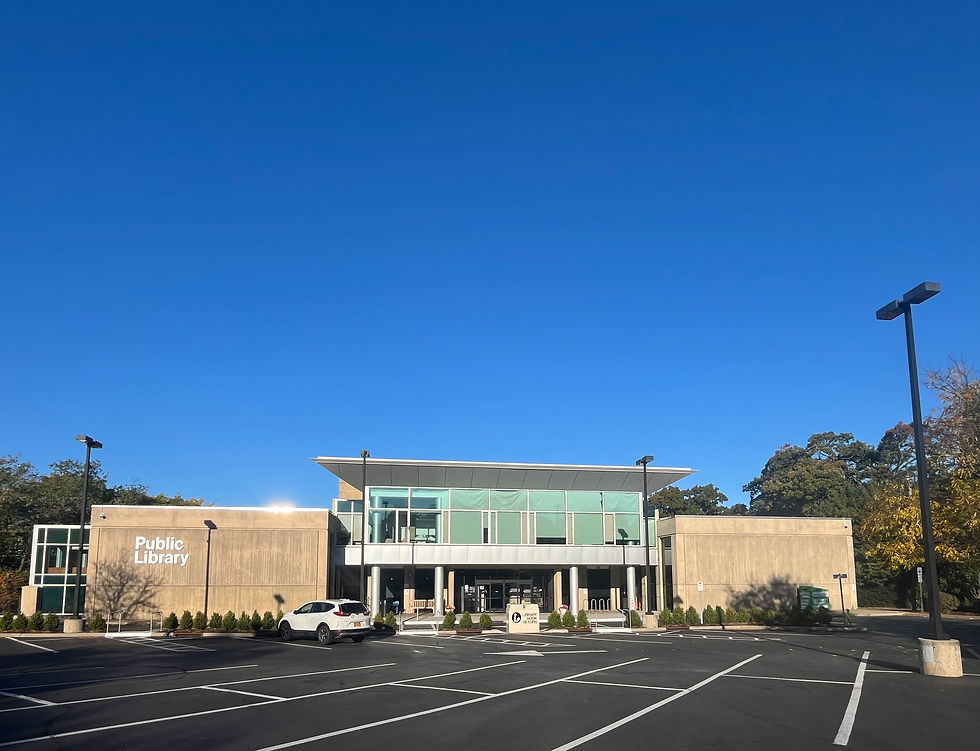
The Manhasset library, my next stop, was established the same month (May 1945) that WWII ended. A drive led by local members of American Association of University Women resulted in the library being built; Ruth Cowell was its first director. One of Ruth’s legacies is a set of oral histories of Long Island. “Her foresight, along with a committed group of patrons, means that we get to listen to memories of the Blizzard of 1888 and the Vanderbilt Cup Races from those who experienced them.” She made these recordings on a reel-to-reel device. In the 1980s they were converted to cassette tapes before being digitized in the 2000s. A note on the collection states that “This material may include outdated attitudes, language and cultural depictions that could cause offense which do not reflect the current attitudes of the Manhasset Public Library as it is today.”

The Scoville Memorial Library, built in the Richardsonian Romanesque (think: a style typified by “blank stretches of walling contrasting with bands of windows, and cylindrical towers with conical caps embedded in the walling” or just “it looks like a chapel”) style in Salisbury, Connecticut, was delightful. In 1771, local blacksmith Richard Smith offered to buy 200 books for a lending library, if the citizens helped pay for them. In 1810, the town voted to spend $100 from town funds to expand the collection, which was gathered and kept in the town hall. With this decision, Salisbury’s library claims to be the first publicly funded library in the United States.

The “chapel” was commissioned in the early 1890s when Salisbury native Jonathan Scoville left $12,000 in his will to build an appropriate structure for housing the collection that was deteriorating in the town hall. A Miss Grace Scoville – the records don’t say whether Grace was a daughter or some other relative – donated the tower clock which still chimes quarter hours. I was lucky enough to hear the bells ring, as they do every quarter hour with four, eight, twelve, and sixteen notes from Parsifal. The building was originally intended to serve as a community center as well as a library, and it contained an auditorium with a piano, a stage, and a balcony. Over the reading room fireplace rests a 15th-century stone carving sent by England’s Salisbury Cathedral. On display are portraits of members of the Scoville family, painted by Ellen Emmet Rand, who also painted three portraits of Franklin Delano Roosevelt. She was the first female artist commissioned for a presidential portrait, and has been called "one of the most important female artists that you’ve never heard of before" according to Alexis L. Boylan, curator of the exhibit who is an art and art history professor and associate director of the UConn Humanities Institute.
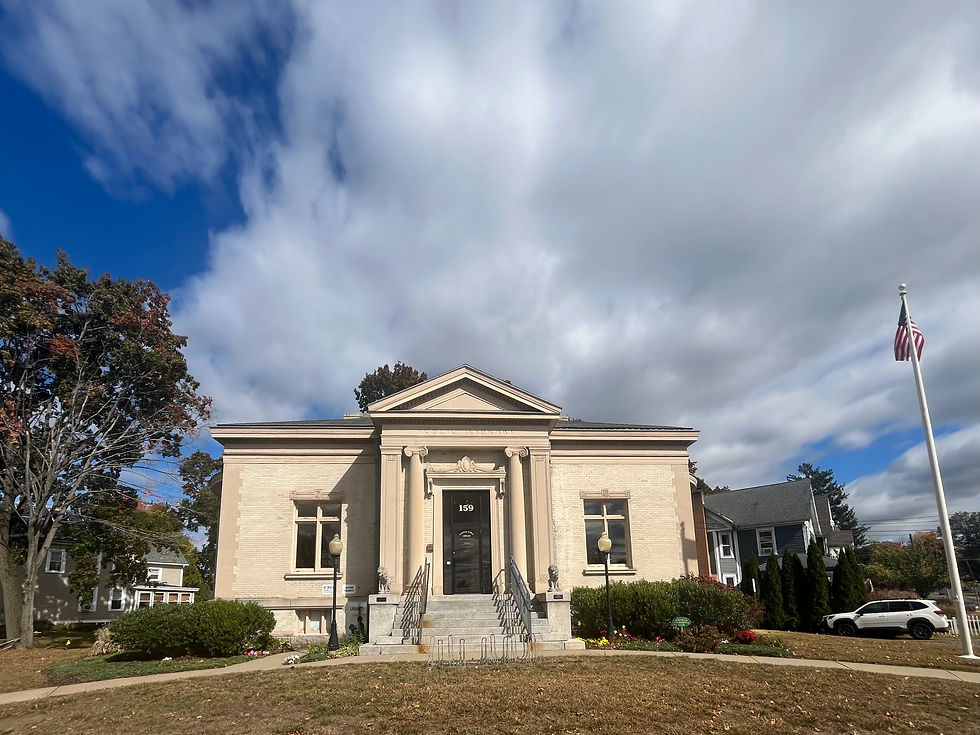
The Pearl Street Library in Enfield, Connecticut, is an archetypical Carnegie library, built in the Classical Revival style. It is compact and appears exactly as it was built in 1914. It was restored in 2006 “using great care to utilize period materials to replicate existing conditions.”
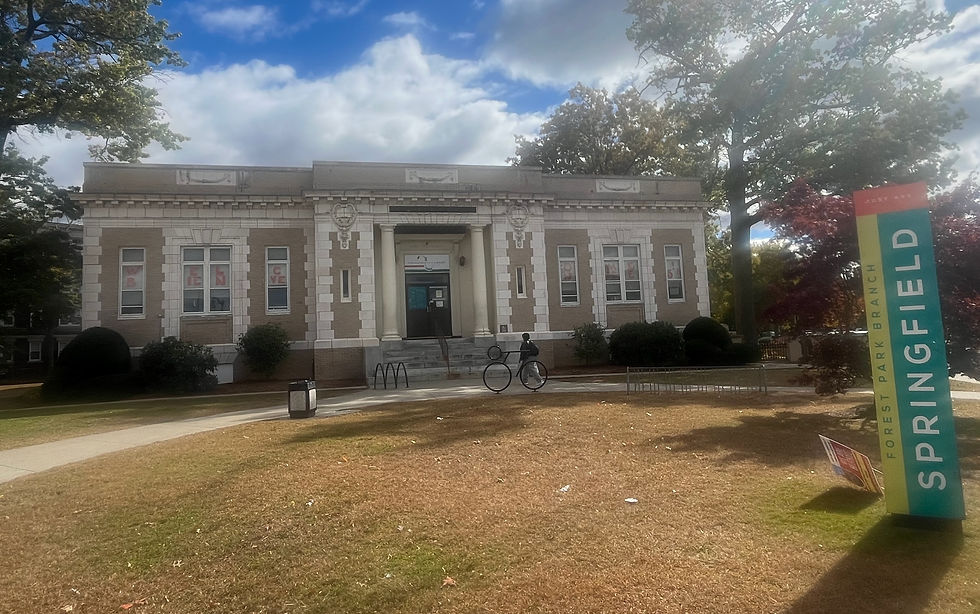
Springfield, Massachusetts, has three fine Carnegie libraries built from its 1905 grants, with each building looking as they did when they were built. This seemed like a lot of Carnegies for a modestly-sized city that has gone through some pretty tough times in the past sixty years – its population peaked in 1960 – and so I’m reminded of how promising the city must have been when Carnegie funded the libraries in a town of some 70,000 residents, where the population had doubled in the two decades prior to the grant.


Just across the Connecticut River from Springfield, Mrs. Elizabeth F. Bogart did not sound like a Chamber of Commerce booster when she wrote to Carnegie from West Springfield in 1914: “This town is composed largely of foreigners, most of whom are quite poor; many are illiterate.” She commended Carnegie for his generosity to Springfield before turning to her experience after twenty-four years as a teacher:
I have always found that the children hardest to discipline in school and on the street were those who had no books to read, for their minds were full of trash…To save our children, we must provide more books and a pleasant library.
Following up the next month, Elizabeth confided that her town had “the poorest library in the state. Perhaps the country.” She again implored Carnegie to do something “for our little children who are growing up without the library habit” and because she was sure that the town had a suitable site and would support the library. Bertram advised her that the town’s authorities would need to contact him. I don’t know what she did to make this happen; I do know that the authorities did get in touch with Bertram, the details were worked out, and the library was built with a $25,000 grant given the following year.
These two letters that Elizabeth wrote may be just about the only physical traces of her path on this earth. Her parents were Irish; she and her sister Hannah were born in Massachusetts and they share the same gravestone in death. She married Samuel Bogart, a “conductor” (presumably, on a train) from Iowa, in 1899 when she was thirty-three, and he died in 1906 when he was only thirty-eight. She appears in the 1910 Census as a forty-six year old widow with a ten year old daughter named Alice and as the head of the household that her older sister, Hannah (no occupation listed), also shares with her. Her obituary, in The Springfield Daily Republican (August 7, 1919), notes only the most essential facts; it’s shorter than the paragraph you just read.
Her letters to Carnegie give a few more glimpses into her character. The existing library was “so dingy.” She’s a wordsmith: dingy feels more appropriate and accurate than its synonyms (e.g., filthy, dusty, dirty). It combines sight (filthy) and smell (foul) while remaining more descriptive and less pejorative than “disgusting.” Dingy’s use peaked in 1868, so a teacher using it in 1914 might not have been as “totally cool” – a phrase rarely appearing in books prior to 1980 – as she may have thought, although she would have been cooler than a teacher saying “rad” today. By the way, dingy has been coming back since 1980 and, as of 2019, its use was as common in books as when Elizabeth used it.
“We teachers,” she continues, “get books from the library for them and do all we can to cultivate their love” of reading. When she went to visit one of the Carnegies in Springfield, she reports on children “with eager little faces devouring stories” and “tiny hands reaching up to the shelves for books.” As she saw these children, “I rejoice for I believe that the love of books has saved many lives.” She describes that library as having “sacred precincts” and, regarding a library grant, implores Carnegie “Will you do this for them?” She combines Charles Dickens’ emotive descriptions with a bit of Oliver: “Please sir, I want some more.”
I didn’t linger in Springfield because my true goal for the day was to reach Sturbridge – and Old Sturbridge Village (OSV) – by the middle of the afternoon. OSV has a special place in my heart (I know, I know, I have lots of these nooks) because of the time I spent there in the late 1990s and early 2000s. I would come up there a couple of times a year to spend a week teaching in the Defense Leadership and Management (DLAMP) program. My courses ran from 9 to 5, Monday through Friday. My students were Department of Defense civilian employees, and the DLAMP program was designed to give them a graduate-level education.
My course was on “strategic policy change” – that is, the notion that successfully changing public policies required a thoroughgoing understanding of the American political system, a notion that now seems naive given DOGE’s chainsaws and appears on point regarding Russell Voss and Project 2025. I loved teaching this kind of course. The students were highly motivated, hoping to advance their careers as well as their understanding.
Back then, the Sturbridge Host Hotel and Conference Center where the training was held was kind of a dump (the first time I stayed there, my carpet was damp and the room smelled of smoke – it was dingy – and it was difficult for me to relax in the hot tub because it was surrounded by so many red and white warning signs), so I usually stayed at one of the local inns. I did not normally fraternize/sororize with my students after class, although I do remember one night just before one of the classes was ending. We were hanging outside by a couple of picnic tables, undoubtedly enjoying adult beverages, when I introduced my class to the concept of ‘picnic table surfing’ (PTS). The military love acronyms.


I developed PTS while in graduate school, although others have almost certainly independently made the same discovery. I was living in a house near Lake Wingra (in Madison, Wisconsin) which had wooden picnic tables in the park bordering it. The tables were not affixed to the ground, and so we learned that if we dragged the tables into the water they were just buoyant enough that up to six of us could sit on the benches and our heads would remain out of the water. For obvious reasons, we did this only when beer had been consumed. If you flashed a light out over the water, you might have seen our heads – in two straight lines of three heads each – sticking out of the water, almost motionless. The final time I did this in Madison, the lights flashing were from a police car that had come to the beach because someone setting off fireworks had alarmed the animals in the nearby zoo. We were instructed, firmly, to remove ourselves and the table from the water. So, besides teaching my DLAMP students about how the civil rights movement was able to accomplish its goals through legislative, executive, and judicial methods, I also taught them the fine points of PTS. No police were involved.
Old Sturbridge Village is a stone’s throw, if the thrower was (King) David using his slingshot, from the conference hotel. Like Lincoln’s New Salem, OSV seeks to recreate a setting in rural New England during the late 1700s and early 1800s. It is a “living museum” with some 60 antique buildings (including a blacksmith shop and three water-powered mills) and a working farm. It is set away from the parking area, so when walking into it one can, if using their historical imagination, believe that they have entered a different era. While teaching in the DLAMP, I had been lucky enough to have visited it at off-hours during off-seasons. One morning there, shortly after it opened, I might have been the first and only tourist there. Smoke was curling out of a few chimneys, and I had a long chat with a costumed interpreter kneading bread inside her cabin, preparing it for the hearth. Outside, I could hear a blacksmith hammer and smell the sulphurous smell of coal smoke from the forge. On today’s gorgeous autumn afternoon, I was not the only visitor, yet I was nonetheless able to walk the paths and lanes alone, remembering those early settlers.


Sturbridge had a library as early as 1804: “[I]t was known as The Proprietors' Social Library and... it was established by thirty-three of the town's citizens 'for the promotion of useful knowledge among the rising generation'... It was a literary society, a book club, and a circulating library," wrote Helen G. Holley, the author of The Library of Sturbridge, a member of the Sturbridge Historical Commission. (Holley also published The Little Songs of Sturbridge.) Miss Emeline Hutchins was the library’s first librarian when she directed it between 1878-1885. She was followed by Lucina Sawyer and Mrs. George Whittemore, Mrs. Jennie Gilbert Monroe, and Emily Haynes. Mrs. Horace (Eunice) M. Locke was the librarian between 1902 and 1908, and noted during her time that
There seems to be a growing tendency to use the library as a reading room, and it is gratifying to see the seats at the table well filled on many Saturday evenings. The librarian is anxious to assist all, and if teachers desiring special material will give a little notice in advance, an effort will be made to have such on the table in time for use.
The grande dame of the Library of Sturbridge (named the Joshua Hyde Public Library after George Hyde donated $20,000 in 1894 for the construction of a library in honor of his father), was Susan Haynes – Emily was her sister – who served as the librarian for 50 years (1908-1958). During her tenure the library opened two additional branches, supervised its redecoration and repainting through President Roosevelt’s New Deal programs, initiated the Inter-Library Loan System and, much to the delight of the library’s patrons, installed an oil heater in 1948. At her retirement, she noted that, “The many hours which my sister and I have spent in the work of the library have been most pleasant.”
Mrs. Mary Ellen Streeter assumed the reins between 1958-1963. Among her accomplishments: “a much needed toilet was installed.” Mrs. Gertrude Hoffman, Streeter’s successor, had a telephone installed which “has added to the convenience of readers who want to phone in for the renewal of books. She also added a collection of stereo records, increased the library’s hours, and hosted its first ever annual book sale before she passed away in 1981. Rounding out over a century of female leadership were the librarians Mrs. Carlotta Heske (1981-82); Grace Littlejohn (1982-88), Loretta Griki (1988-92), the library’s first ‘professional’ (degreed) librarian (who moved the library to a digital catalogue while she supervised the construction of a new addition); Ellie Chesebrough (1992-2010), who “supervised the purchase, installation, and performance of a sophisticated computerized system which has revolutionized the library’s internal operation and services to our patrons;” and Becky Plimpton, the current director, now in her 15th year of service. For the past 150 years, the library named after a man has been led by a woman.
I worked at the library until the librarians graciously reminded me that it was closing in five minutes. By the time I had packed up they were there to walk me out the door. On a chilly fall light, the two librarians walked through the dark to their cars, another day of service to the public concluded. I slept just down the road outside the Scottish Inn, which had a large circular drive lined with flowers. I walked the loop several times, as the frost crept in, looking for the best place to park (away from the construction and refrigeration trucks), ending the day with 12,938 steps. It was a great day.
I will confess that I almost attended a recovery meeting, but did not. The meeting was held in the church adjacent to the library at 7 pm. Only a few cars were there, and I didn’t see anyone going in, and so I decided that I would rather spend the hour writing at the library. I hope that others in recovery would have understood and accepted my decision, although if they had the chance they probably would have advised me otherwise.


Comments