


Day 11, Thursday February 22, 2024: Mobile, Alabama to Oxford, Mississippi

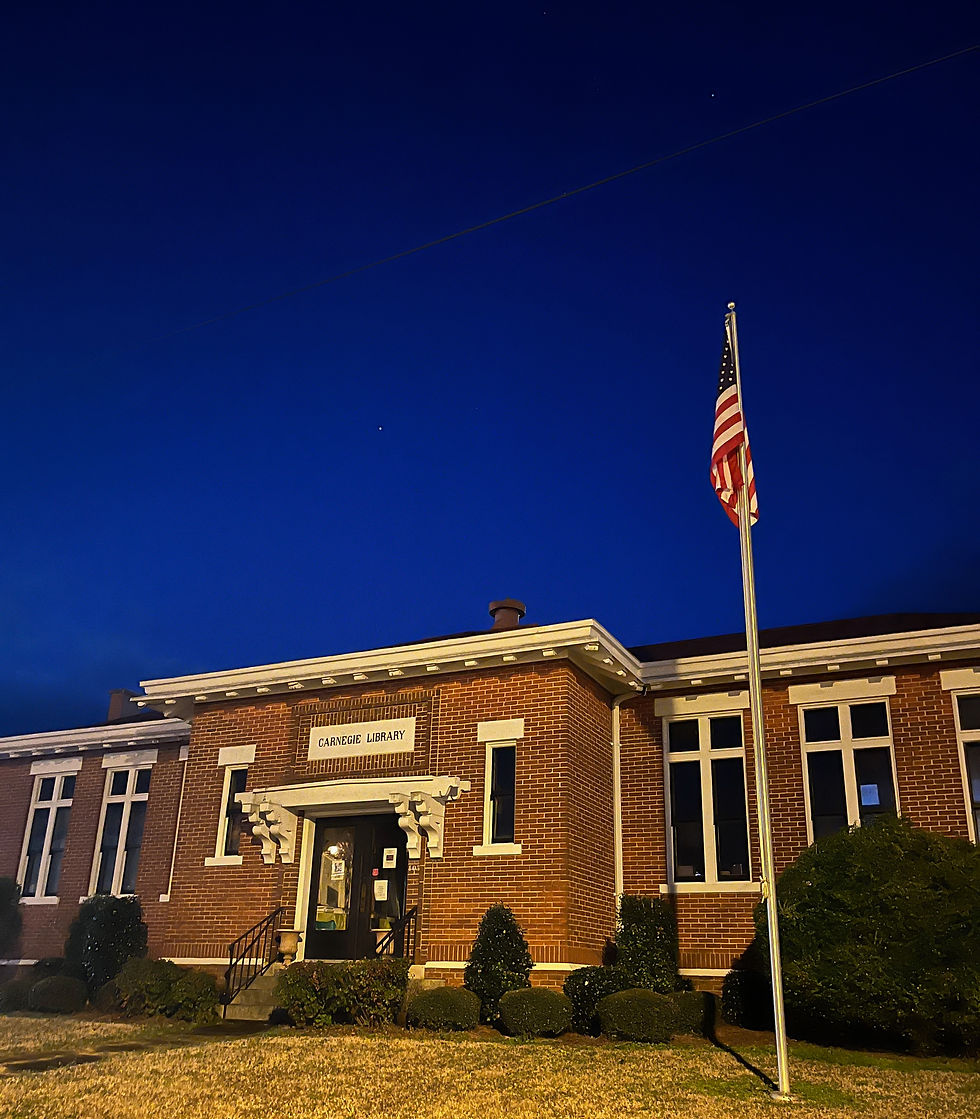
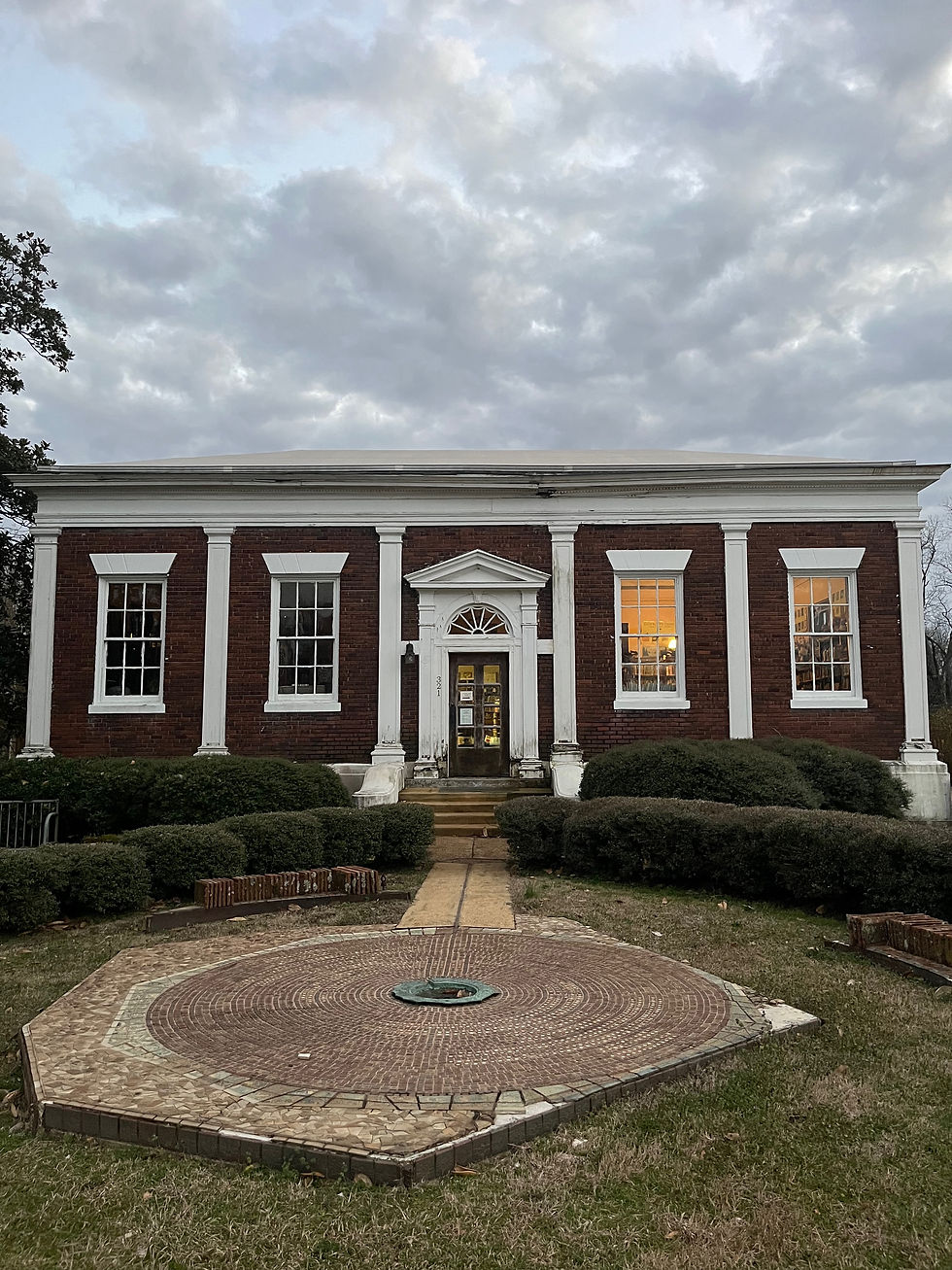
Carnegie libraries visited: Okolona and Houston, Mississippi
Days sober: 245
Alabama (“We defend our rights” is the state motto) gave me a little gift this morning. When turning off my iPhone last night, I inadvertently put it in SOS mode. The SOS mode disables the cellular service I needed to use my maps and apps. To turn SOS off, I thought I needed a wifi connection, so I drove back to the Ben May Library because I knew that the library would have one. Libraries are good that way. I missed the turn to the main parking lot and instead pulled into the lot of the Mobile Library History and Genealogy Branch. Great, thank you, lack of Google Maps, for this serendipity. I described my project to Tanisha, who was working the front desk, and she pointed me to the shelves containing the various reports of the Women’s Clubs of Alabama.
The Alabama Federation of Women’s Clubs YearBook 1920 – this was the earliest yearbook in the archives – proclaimed that
The permanent values of human life are expressed in literature as nowhere else. So we must remind ourselves that [this federation] is to nurture those values…The public library should be our natural gathering place, and the Women’s Club could be made a social center…Let ‘A Public Library for Every Town’ be the Slogan of this our Centennial Year.
The back of this volume reported to the Federation the contributions the various state clubs made. The Quest Club, for example, donated $10 ($159.10 in 2025 dollars) to its city library. Every little bit counts.
Ben May is not a Carnegie library. It could have been, as Carnegie had offered Mobile $50,000 in 1910 to build one. The sequence of events is difficult to follow, as several of the town’s residents had written to Carnegie, without coordination, beginning in 1899 and the Carnegie archives do not appear to have a complete record of the correspondence. Moreover, the signatures on the letters are often challenging to read.
When Mrs. Lawrence Moore wrote Carnegie in that year, she addressed the concerns that would, years later, scuttle the project: “Newspaper articles, published during the labor troubles in your city, had represented you as one of those sordid, grasping men whose greed for gain warps both soul and body.” However, “The first sight of the strong, alert, but kind face, pictured with [Carnegie’s] life story, dissipated prejudice…” Several paragraphs of flattery follow, along with a paean to Mobile. Then, the ask:
May I not ask, that, in the fulfilling of the Divine behest “give” – in which you seem to be luxuriating – you will take into consideration the opportunity and desirableness in placing that incomparable educator, a Public Library, in the City of Mobile?
No response is reported. Another letter that caught my eye came from Mrs. Harry (Belle) Sigel (maybe?) who began her letter to Carnegie with
Doubtless you will be amused that a mere woman should venture to write to you on the subject which I am about to broach, but I believe you to be a straightforward man who will not misjudge my motives…
I have heard people say here that they could do nothing unless they know someone who has personal influence with you. I do not believe this as I conceive your object to be to do good and when the cause is worthy you will not hesitate…
I am just simply longing for good books and of course cannot have more than the usual modest library of impoverished Southern people.
Mobile already had a public library “organized by a number of ladies” who had also raised enough money – $5000 – to buy a lot that they pledged to give to the city if it were used for the purpose of hosting a public library. Katherine Mahorner (if I read her scrawled signature correctly) contacted Carnegie in 1910 on behalf of the Mobile Public Library Association, informing him that the Association had “acquired a desirable site” for a library and that she believed the city would make the appropriations necessary to fund operations. No response is reported.
After the mayor got involved, Bertram asked “Will you kindly divide the population of 30,000…into white and colored…? Please also say whether the colored people are able to use the Library Building or whether another building is to be put up for them.” The Mayor replied that about thirty percent of the residents were Black, and that “Should we succeed in securing a library for the white people of the City, we should endeavor to provide the colored population with library requirements of an adequate nature,” which can easily be interpreted as “if we get a ours, maybe they’ll get theirs.”
Carnegie’s philanthropy was revolutionary (“the man who dies rich dies disgraced”); his library gifts pragmatic and democratic (a town could obtain a grant only if it used tax dollars to support the library, with this decision made by elected officials or the public through voting); and his policies toward race phlegmatic. His grants directly supported the construction of public and academic libraries for Blacks. (I was unable to determine the exact number; it’s not large) Yet he also funded public libraries that were strictly segregated, and it is impossible for me to think that he (or, more likely, Bertram) was oblivious to the fact that requiring tax support would strictly limit the number of libraries built for Blacks.
The Carnegie archives do not offer evidence as to why Mobile failed to follow through with its grant. The only source – and it’s an undocumented website – I could find that gave a reason stated that the city rejected the offer “because local unions didn't want it.” By the beginning of the 20th century, the American Federation of Labor (AFL) existed in Mobile, so that explanation is plausible. I question whether the AFL had sufficient incentive, and even more so the power, to squash this grant had the town’s leaders truly wanted it. Mobile reached out again to Carnegie in 1923, and was informed that he was no longer funding libraries.
Emma Cortez Harris (“Miss Emma,” as she was known) was the grand dame of Alabama libraries (see “Miss Emma” presentation to a committee in the effort to get her inducted into the Alabama Hall of Fame). Born in 1879, she earned her college degree in 1921 at the age of 42. In 1918, one year after her husband, Louis, passed away, she was named head of the private library that preceded the creation of the Mobile Public Library. She was instrumental in the efforts to establish a public library, and she became its first librarian when it was dedicated in 1928. Unusual for the times, she helped to float the $250,000 bond issue that was needed to finance that library.

She was not a “I never leave the library librarian,” if there even is such a person. Her travels made the headlines (in The Mobile Times, at least): “Mrs. Harris Enjoys Interesting Trip.” In October 1929 Miss Emma traveled to Indianapolis to visit the library there, as the Mobile library was patterned after that one. While traveling she also visited the libraries in Kalamazoo, Grand Rapids, Detroit, Cincinnati, Chicago, St. Louis, Evansville, Louisville, and Battle Creek, as well as other small libraries in Michigan. (I wish I had been on that library journey.) In 1961, Mrs. Harris was named Mobile’s “First Lady of the Year.” The commendation read:
Your career in library work reaches back over the years to 1918 and the record is filled with many instances in which you made great personal sacrifices to make books and other publications available to the reading public.
There was a time during the Great Depression when you and others on your staff worked without pay and without lights and heat in the library.
You very successfully served as librarian from 1928 until 1945 and at the age of 82 are still carrying on as head of the library’s research department of southern history.” (February 3, 1961; probably The Mobile Times)
Like many accomplished women of the day, Miss Emma was the member of many organizations including the Women’s Club, the Business and Professional Women’s Club, the American Library Association, the Daughters of the American Revolution, and, yes, the United Daughters of the Confederacy.
When I was ready to end my much too short visit to the archives, I learned that AT&T’s cell service was out of commission for much of the morning. My phone went on SOS mode not because of what I had done. Good fortune, anyway, because I would not have stopped at the archives otherwise. Technological failure sometimes leads to gratifying adventures.
Having spent more time in Mobile than planned, I just took pictures of the Carnegie libraries in Okolona and Houston, Mississippi as I passed through those towns. The Carnegie archives do not make any references to any roles that women played in their towns’ efforts to obtain a library.
I thought it would be easy to find a place to park overnight on the Ole Miss campus; I know my way around universities. I slipped into one promising lot – lots of spaces; also, lots of cars – although after an hour or so it had emptied and I sat in the last car sitting there. Sticking out like a sore Goldfinger, I left and eased into the parking area of a Marriott Gardens hotel that was just around the corner.
I think hotels will become my go-to camping home. Cars park there every night, so no one will raise an eyebrow seeing my Subaru, and hotels have lobbies, often with free coffee, sometimes free wifi, and always with bathrooms. Moreover: a decently dressed, older, white, dude is not going to be questioned as to what he is doing there.


https://keonhacai.cam/ dạo này thấy vài người nhắc nên mình cũng bấm vào xem thử cho biết thôi. Mình không có soi kỹ nội dung hay gì, chủ yếu nhìn cách họ làm giao diện có dễ dùng không. Ấn tượng đầu là bố cục khá thoáng, các mục được chia theo từng khối nhìn phát hiểu ngay chứ không bị nhồi chữ. Mình lướt trên điện thoại vẫn thấy ổn, chữ và khoảng cách vừa mắt nên không phải nheo mắt đọc. Cái mình thích là thanh menu để chỗ dễ thấy, bấm qua lại giữa các phần cũng nhanh, không phải tìm vòng vòng. Nói chung cảm giác như họ sắp xếp để người mới vào cũng không bị…
Bài viết của bạn viết gọn gàng, đi thẳng vào phần cần biết nên mình đọc một mạch là hiểu, cảm ơn vì đã chia sẻ nhé. Mình cũng hay xem thống kê XSMB hằng ngày, nhưng trước đây mỗi lần tra cứu phải mở nhiều chỗ khác nhau nên hơi tốn công. Sau đó mình tự tổng hợp lại để khi cần thì lật lại nhanh hơn, và mình để chung trên soicau247.com cho tiện theo dõi theo ngày. Không phải ai cũng có thời gian ngồi lọc số liệu, nên có một nơi gom lại như vậy cũng đỡ rối. Nếu bạn nào cũng có thói quen xem cập nhật mỗi ngày thì có thể xem thêm ở…
I appreciate the practical information shared throughout this article. Exploring Los Pinos LLC Staten Island can help local readers better understand the business and become familiar with services that may be useful for households and property needs.
Preventing damage is often easier than restoring a rug after serious wear or staining has already occurred. Protective treatments can be useful in homes where rugs experience frequent foot traffic or occasional spills. Professional rug protection services can help homeowners take preventative steps designed to preserve the appearance and condition of their rugs for longer periods.
Construction sites dealing with large rocks and aggregate materials need efficient ways to process material without slowing down the overall operation. Crushing equipment can help transform oversized material into more usable sizes. Professional rock crushers services in Reno-Tahoe can provide contractors with practical equipment solutions for roadwork, excavation, aggregate processing, recycling, and site-development projects.