


Day 133, Tuesday October 15, 2024: Patchogue, New York to Glen Cove, New York

Updated: Dec 3, 2025
Carnegie libraries visited: Northport, New York
Days sober: 481
The day was library heavy, but Carnegie light: only one on my route, a counter-clockwise loop around Long Island. After a chilly night, I was glad to warm up with a cup of joe at Socially Good Coffee. I was delighted to see a poster for Patchogue’s Sober October Popup Bottle Shop and Networking Mixer, where I could have a complimentary Espresso Martini mocktail if I had stayed two more nights. Tempting as it was, I moved on.
This morning Ann Patchett published the essay in the New York Times “The Decision I Made 30 Years Ago I Still Regret.” Her decision and regret? Using email, which allowed her to connect to people all over the world and which also sucked up a huge amount of time that she could have better spent writing novels. As she has written nine novels during those decades – and each of the ones I have read (Bel Canto, Tom Lake, and The Dutch House) have been terrific — it doesn’t seem that email blocked her muse. Still, perhaps she would have written nine more?
One quote that caught my eye, written by the Irish author Niall Williams, goes “You can’t correct the mistakes of a lifetime. You are your own past. These things happened, you did them, and have to accommodate them within your skin and go forward. Even if you could – and you couldn’t, can’t – there was no going back.” Indeed. I did the things that I did.
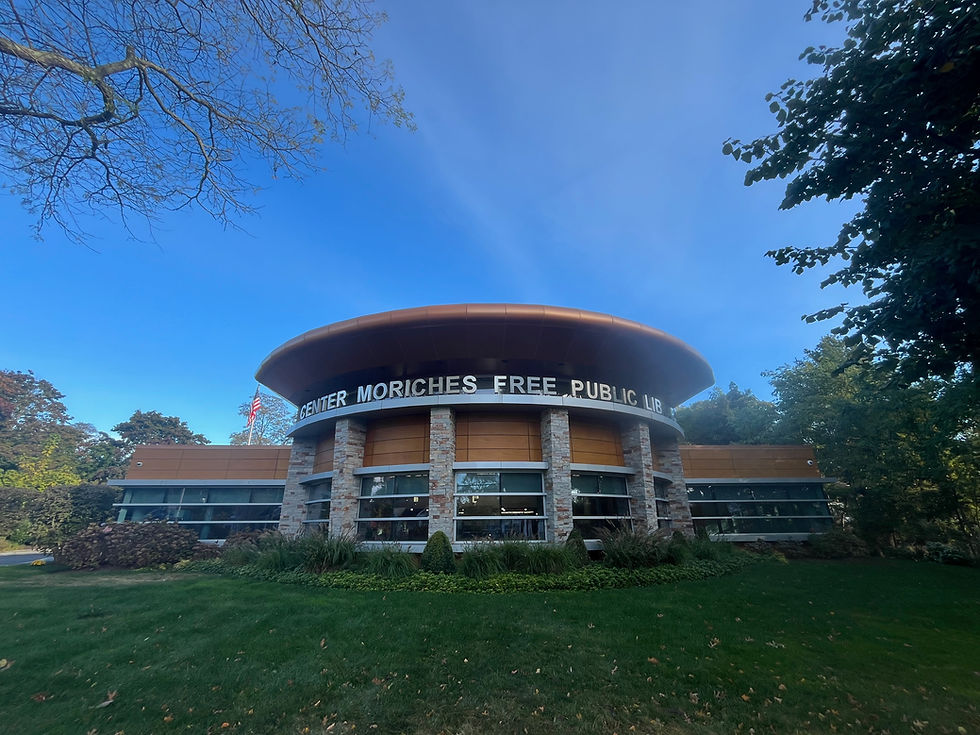
The virtual absence of Carnegies did not make the drive uninteresting. Hardly. The library in Center Moriches had an unusual building, with a circular mainly glass facade flanked by a continuation of those windows on flat walls. The Hampton Library, in a pleasing home-like framed building, had a reading room overlooking a garden. I wrote for a while at a large oak desk, on a floral Turkish rug, with gourds as a center-piece. For me, this is an almost ideal way to spend a morning. It is not as glamorous – and certainly not as expensive – as the Kayon Resort in Bali, which is “perched on an Ubud hillside [and] surrounded with the holy Petanu River and lush and tropical rainforests” and, I have to say, pretty effing fantastic. (If you happen to be in the neighborhood, I highly recommend a visit.) Still, today, I’m grateful the serenity I find here.


The East Hampton library, granted a charter by the state of New York in 1897, was initially staffed by volunteers and had a Board of Managers comprising 12 women. Ettie Hodges was hired as its librarian in 1898, and she served in that capacity for 56 years. The youngest of five children, Ettie was born in East Hampton in 1879. Although the town would soon become a haven for the wealthy – two First Ladies, Julia Gardner Tyler and Jacqueline Bouvier Kennedy Onassis grew up there – it was largely undeveloped at the time that Ettie was born: her family lived on a farm at 189 Main Street, a one minute walk from where the library came to be built. (Although it’s not currently for sale, expect to pay north of $4 million when it is.) She graduated with the first class from the local high school in 1895 and began her library career three years later.

As we now should suspect, like many librarians Ettie was active in various community organizations: St. Luke’s Episcopal Church, the Ladies Missionary Society, and the Ramblers Literary Society. She remained unmarried for almost 30 years while engaged in her library work (Her online biography states that it was “unusual” for a woman to not to marry at the time, but my research on librarians suggests it was not unusual for them.) Through her library work, she became close to Morton Pennypacker, the local historian. In 1930 she convinced him to give his large collection of Long Island memorabilia to the library. (“No other small town in America has such a collection of rare materials tracing the region’s history back to its origins.”) Six years later, they married: she was 57 and he was 64. It was the first marriage for both. The townsfolk were relieved, as their relationship had long been a topic of interest.
Ettie retired when Morton became ill in 1955; he died the following year. They did not have children. Ettie “doted” on her nieces, though, and one of them came to live with her until she died in 1970. She and Morton are buried in the South End Cemetery, across the street from Ettie’s childhood home.
The East Hampton library moved to its current location in 1912 on land donated by Mary Lorenzo Woodhouse, who with her husband also financed the neo-Elizabethan building, “designed at the request of the many local citizens who wanted local architecture to resemble the pre-seventeenth buildings of the Kentish village from which the original settlers had come.” The Woodhouses could afford their generosity. For their daughter Marjorie’s 16th birthday they had given her “The Playhouse,” a Tudor home designed by the popular architect F. Burrall Hoffman, Jr., which included 30 foot vaulted ceilings and a 75 foot long Elizabethan-style salon to complement its five bedrooms and five bathrooms. In 2024, the iconic house was listed for sale at $16.5 million. The Woodhouses also provided the initial financing for the town’s Guild Hall in 1931, one of the first multidisciplinary centers in the country to combine a museum, theater, and education space under one roof, and they supported the Clinton Academy, the first chartered secondary school in New York (1784). It looks like Mary’s husband earned the money, and she determined to what public purposes it should be put. In 1930, when Mary and Lorenzo made substantial additions to the library, Mary Gardiner Thompson and her husband Jonathan built the Gardiner Memorial Room to house the Pennypacker Long Island Collection.
Just down the block from the library is the home of Mary Groot Manson, a wealthy Long Island suffragist who was the leader of both the Woman Suffrage League of East Hampton and the Women’s Political Union of Suffolk County and a subject of a John Singer Sargent portrait. Although wealthy, she got into the grit of political action. She frequently hosted women’s suffrage meetings at her home; I wonder if Mrs. Woodhouse attended any of them. Groot took part in a cross-island demonstration in 1915, when the right for women to vote first appeared on the New York ballot, carrying (well, motoring) the Torch of Liberty from Montauk Lighthouse through the East End before passing it off mid-island to fellow suffragist Louisine Havemeyer. (The referendum failed to pass.) She is perhaps the most famous of the Hampton’s suffragists, maybe because of the fact that a historical marker stands outside her home.

Amagansett’s library is in a weathered, shingled home built in 1790 by Samuel Schellinger. It was a gift from Mrs. Mortimer Levering. The reference for this statement is the pamphlet Amagansett Lore and Legend, by Elizabeth B. Schellinger, although that source, written in 1948, actually lists the donor as Major Richard Levering. Which makes me wonder: who really was the donor? Is the library’s website correcting the historical record, or embellishing it? I’m guessing the former.

The Springs Historical Society and Community Library, a subscription library, resides in a shingled, weathered, home built by Ambrose Parsons in the late 1700s. The home was given to the town by Elizabeth Parker Anderson (1893-1975) on her death “to be used as a library for the people of Springs.” Anderson was an accomplished painter who lived and worked in Springs beginning in the 1950s. A dedicated member of the East Hampton community, in 1957 she co-founded, with fellow artists John Little and Alfonso Ossorio, the Signa Gallery, East Hampton's first commercial gallery devoted to abstract art. At a memorial exhibition in 1976, the Filipino-American artist Alfonso Ossorio reflected that “Elizabeth Parker devoted her life to her art and to a constructive involvement with other people. Especially those in her chosen field of work. Quietly, unobtrusively, undemandingly, she persevered in developing her painting into a body of work filled with gaiety and a sense of the contrasts, calms and tensions of life. She was singularly modest about what she created, so much so that even her friends may well be surprised and delighted with the variety and richness” of her artistry.

The Sag Harbor library marries the classical and the modern: Beaux Arts in the front, Bauhaus in the back. The library was commissioned and built in 1910 by Margaret Olivia Slocum Sage (1828 – 1918, known as Olivia) in memory of her grandfather, Major John Jermain, as a gift to the people of Sag Harbor. Sage herself had a before and after life. For the first 20 years of her adult life, she lived with her parents and was a schoolteacher. During the Civil War, she served as a governess for a wealthy family. At the age of 41 she married the 53 year financier, railroad executive, and widower Russell Sage. In 1906, when Olivia was 78, Russell died and left her his entire fortune: about $70 million.

That same year, Olivia published the article “Opportunities and Responsibilities of Leisured Women” in which she outlined her views that privileged women had the responsibility to help others. And help she did. Her biggest gift was to create the Russell Sage Foundation, which commissions studies on social problems and their solutions. (In 2023, the RSF had over $400 in assets.) She financed a broad range of educational institutions (some 20 of them) as well as the library in Sag Harbor, where she maintained a summer home.
The Cutchogue library is unusual because it shared its building with the Independent Congregational Church. In the 1980s the church allowed the library to buy the building outright, and today the “church” part of the building is devoted to a children’s room and meetings. The Baiting Hollow Free Library serves its small community from a small white frame building.


Emma S. Clark (1836-1889) and her sister, Annie, came to live in the United States with their uncle Thomas Hodgkins after they were orphaned at an early age. Emma never married and remained at Hodgkins’ Brambletye Farm in Setauket, where she cared for her uncle, as long as she lived. After her death, at age 52, Hodgkins, who turned his small candy store into a multi-million dollar candy manufacturing business, gave the land, building, and his own collection of 1500 books to a library named after Emma. At the library’s dedication in 1892, John Elderkin, editor, publisher, and member of the Library Board of Trustees, at the dedication of the Emma S. Clark Memorial Library, October 3, 1892, said about Emma and her father: “In [establishing this library] it has been his purpose to perpetuate the memory of a good woman, among the people with whom she dealt in kindly and helpful relations for nearly a quarter of a century, by an institution of a useful, benevolent and elevating character, which shall be a means of pleasure and culture for all time to come.”


Northport had a Carnegie library, which was converted into the Northport Historical Society Museum in 1974. I didn’t stop by that Carnegie – it wasn’t on my list, as it is no longer a library – and its replacement was a brick building with a mansard roof that just didn’t grab my interest. I rolled into Glen Cove late in the afternoon, which is no longer very late as the sun was doing its “you realize it’s autumn, right?” thing.
The town was quite hilly, and this proved a bit challenging in terms of sleeping in Goldfinger: it was difficult to find a parking space that was both level and on the downlow, and iOverlander had no suggestions. I cruised through the downtown and surrounding neighborhoods by car and by foot. The parking lot behind the police station? Probably safe, but likely to be interrupted by sirens. The parking deck? The top lot, open to the sky and promising, was chained off; the interior decks give me the heebies. The streets were either too steep or lacked suitable parking spaces. (A suitable space is on a street with other cars, where I can slip in discretely.) I landed upon a townhouse community on the top of a knoll, which had a handful of open slots without “Reserved for Resident” signs, and I guessed that the residents would be unlikely to look out their windows for stealth campers by the time I pulled in for the night.

I planned to return there about 10 pm so I could catch a 7.30 showing of the movie The Apprentice, the biopic of Donald Trump’s ascent as a developer in Manhattan. Wenlei Ma’s review in The Nightly sums it well: “The film is a well-paced and often entertaining story of how Trump evolved from an insecure blustery young man into a still insecure and blustery older one, but someone with a greater grasp of how to manipulate others and egomaniacally impose himself.” It's definitely not hagiography, yet I didn’t see it as utterly damning either (except for the scene in which he rapes his wife so, yeah). The film has it that Trump was not born a beast; he allowed his lawyer Roy Cohn to train him to become one. I skipped the popcorn.


Comments