


Day 131, Sunday October 13, 2024: Cape May, New Jersey to Avon-by-the-Sea, New Jersey

Carnegie libraries visited: Ridley Park, Delaware; Paschalville, South Philadelphia, Wyoming, Lehigh, McPherson Square, Richmond, Tacony, all in Philadelphia, Pennsylvania; Belmar and Avon-by-the-Sea, New Jersey
Days sober: 479
So many different Americas were on my route today, from sea to shining sea: Cape May, New Jersey to Avon-by-the Sea, New Jersey.
Cape May is one of the nation’s oldest beach vacation destinations, and it is said that it has more Victorian homes than anyplace other than San Francisco. During summer months, one has to buy a tag to use the broad sand beach ($10/person/day; no charge for children under 11), which helps to keep the beach clean, uncrowded, and more affluent than if free. It’s an upscale place.
My drive north to Philadelphia took me through some of New Jersey’s richest agricultural areas. Pan flat, the region boasts floriculture, chicken eggs, blueberries, corn, soybeans and, in the fields around Vineland, vineyards. A pleasant Sunday morning drive.
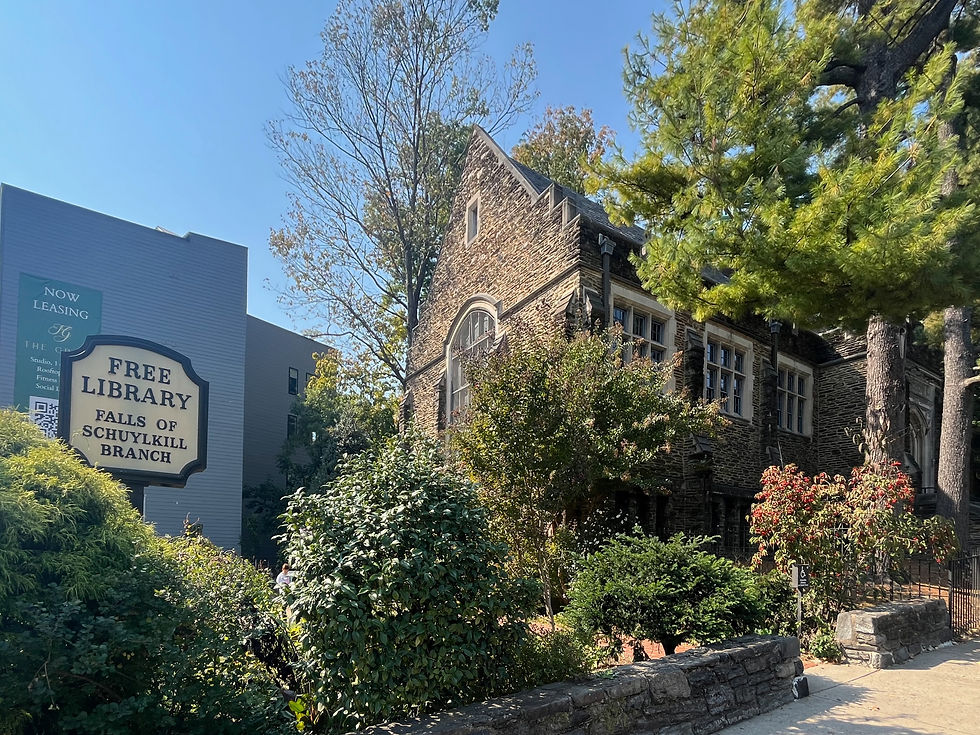
And then, Philadelphia. Carnegie provided the City of Brotherly Love a single grant to build 25 branch libraries, for between $20,000 and $30,000 each. Seventeen of these libraries are still open. For some reason – Impatience? Indifference? Indecisiveness – I chose to visit only seven. Each of them are closed Sundays, but the traffic was light and the parking easy, so I did quick stop and shoots at each one. A couple of them – Ridley Hill, and the Falls of Schuylkill, for example – were in lovely neighborhoods. Others were in, to me, somewhat dicey neighborhoods. The Paschallville Branch was worse for wear, and closed for repairs and renovation. The Wyoming Branch and Lillian Marrero Library, in North Philadelphia, and the Macpherson Square Branch in Kensington were in neighborhoods that had experienced commercial decline and white flight. Port Richmond, is a neighborhood that has long been home to immigrants from Poland, Ireland, Germans, Lithuanians, Italians, Albanians, and Puerto Ricans, as well as an historic Jewish community; recently, it has had a Brooklyn-in-Pennsylvania vibe.




The library I want to highlight is named after Lillian Marrero “a community activist and beloved librarian at the Lehigh Avenue Branch library in North Philadelphia.” Reforma, The National Association to Promote Library and Information Services to Latinos and the Spanish Speaking, writes in a tribute:
Lillian started working as a librarian at the Free Library of Philadelphia in 1991, and was known for her passion to help the underprivileged. While serving at the library, she became actively involved in the community activities, and developed various educational initiatives to assist low income people with their needs, including housing, job search, and English and computer technology learning. formed partnerships with local community groups, especially the Latino community. Her efforts and dedication helped raise the funds for the renovation of the Lehigh Avenue Branch…Lillian went beyond the call of duty and became a beacon of the community. She did not only spend much of her time helping people, but also swept the street and sidewalk outside the Lehigh Avenue branch, picked up litter on the grounds, and planted trees and flowers in the garden she maintained at her branch.
Lillian was born in France, but she considered Puerto Rico her home. She married Hector Rios in 1986 in Puerto Rico, and had a daughter, Tanya. “She received a bachelor's degree from Puerto Rico University, then a master's in library science from New York State University at Albany, a master's in instructional design at Sacred Heart University in Puerto Rico” (Free Library of Philadelphia, Social Science and History Department). Lillian also completed a master's in educational technology at Temple University where she worked part-time as a librarian before joining the Free Library. Lillian held various leadership positions at the American Library Association, and was a longtime member of the REFORMA Northeast Chapter, as well as a member of the Pennsylvania Horticultural Society. In 2005, The Lehigh Avenue Branch Library was named after [her].

Most of the desolate urban areas I had visited earlier on this trip seemed also to be depopulated; street traffic was usually minimal. On this warm, sunny, mid-autumn day the sidewalks, stoops, and parks were teeming with the dispossessed. Many were sleeping, or passed out, or both. Others were staggering, stumbling, walking the walk of the elderly, overmedicated, bleary. Hope was not in the air, or not in a way that I could smell (unlike marijuana, which I could).
The Lou Reed song “Dirty Boulevard” came on to my Spotify.
Pedro lives out of the Wilshire Hotel
He looks out a window without glass
And the walls are made of cardboard, newspapers on his feet
And his father beats him because he's too tired to beg
He's got 9 brothers and sisters, they're brought up on their knees
It's hard to run when a coat hanger beats you on the thighs
Pedro dreams of being older and killing the old man
But that's a slim chance, he's going to the boulevard
This room cost 2,000 dollars a month, you can believe it man, it's true
Somewhere a landlord's laughing till he wets his pants
No one dreams of being a doctor or a lawyer or anything
They dream of dealing on the dirty boulevard
Give me your hungry, your tired, your poor - I'll piss on 'em
That's what the Statue of Bigotry says
Your poor huddled masses, let's club 'em to death
And get it over with and just dump 'em on the boulevard.
Released in 1989 as a description of the seamy side of Manhattan, it felt like it could have been written right here, right now. It feels like a miracle – or just plain luck – that I’m driving comfortably through the morass instead of sleeping in my vomit or praying I have just enough to buy a little bit more.
I don’t know what I would have thought or felt about these humans if I were not myself an alcoholic. Empathy, I hope. I can’t help but think that the empathy would have been more intellectual than visceral: “I can understand their situation” rather than “I am experiencing the pain that they must feel.” Now I know and feel that it is really only luck that puts me (literally) in the drivers’ seat today, rather than in the gutter inhaling the exhaust.
In the “before days” I was puzzled as to why so many of the alcohol recovery counselors I had met were themselves recovering alcoholics. Sure, I guess, I could understand why recovering alcoholics would be tempted to become addiction counselors. Having been saved from jails, institutions, or death, it is understandable that they wanted to share their insights with others hoping to escape the same fates. More broadly, I knew that people often sort into the professions that have special appeal to them: biologists find biology compelling, and woodworkers take pleasure in working with wood. It wasn’t clear to me, however, whether being in recovery was essential to being an effective counselor. In terms of conveying information about addiction and recovery, there’s no reason why those in recovery would have either more or less competence than those who are not. If anything, recovering alcoholics might be more susceptible to unverifiable folk wisdom. In terms of empathy, I’m not convinced that only those who have experienced a condition or situation can truly empathize with it. For example, I reject the idea that the only person who can write knowingly about an identity – race, gender, orientation, etc. – must be of that identity; if I accepted that, I would not be writing this book. Still…there is something about sharing an identity that allows one to say to someone else of that identity: “I truly understand what you are experiencing, as I have experienced it myself.” Only another alcoholic can really know the feelings of “I can’t stop. I want to. I’ve tried. I just can’t do it.”

Princeton, not a town lacking libraries, has no Carnegie. Princeton does have a Carnegie connection, however. Andrew Carnegie donated the funds to build a lake (the aptly named Lake Carnegie) near Princeton University for use by its crew team. My dad told me about this as he remembered taking the Yale crew he coached to practice there on their way to the Head of the Charles regatta. When I was a child, black and white pictures from his crewing days were in a rarely used hallway in our basement. In those pictures, he was so young, so handsome, and so happy.

My route out of Philly took me north and east to Avon-by-the-Sea, pronounced “Ahvon” which I’m glad I looked up so I wouldn’t appear to be a rube. A whipping north-to-south wind drove me off of the Coffee Surf Company deck where I was writing. I almost had to tack back and forth on the boardwalk while heading into the wind, and on the return trip I let my shirt serve as a spinnaker to blow me back home. The homes of Avon, at least those along the coast, are mansions. So much wealth: in 2010, the median price of a home there was nearly a million dollars. The town is almost all (97%) white, which made Cape May (90%) seem a model of racial diversity.

The Avon library is a neat and tidy Carnegie, built in 1916. Miss Valeria F. Penrose and Miss Frances Winans wrote the Carnegie Corporation in November of 1915 to request funding. Although Carnegie required towns to have a minimum population of 1000 in order to receive funding – and Avon’s full-time population was a mere 707 – yet Penrose and Winans were able to persuade Bertram – well, after the town’s elected officials confirmed this – that Avon’s summer population of some 4000 beachgoers, and the promise of growth in the town itself, deserved funding. And they got it: the smallest town to receive a Carnegie grant (according to the library’s webpage). As Miss Penrose wrote, "We are grateful. The starved lives in little Avon are now assured of practical mental food with adequate housing and the people will increasingly avail themselves of the benefits, the summer people too."
In resort towns, the streets are often lined with parked cars. It was easy for me to slip quietly along the curb of a tree-lined street for the night, and that’s what I did.


Comments