


Day 129, Monday August 12, 2024: Narragansett, Rhode Island to Queens, New York

Carnegie libraries visited: New Haven Fairhaven, West Haven, Derby, Norwalk, and South Norwalk, Connecticut; Mount Vernon, New York
Days sober: 417
I wasn't having much luck finding information about women and libraries while traveling throughout New England. (When I returned home and explored the archives, I had much better luck.) The older libraries – and there were lots of libraries in the northeast built before Carnegie, although they were primarily by subscription and thus not free to the public – were mainly built and run by men, as women did not become prominent in the library profession until the late 1800s.
Carnegie’s library generosity, which came about at the same time that women’s clubs and their library advocacy were flourishing, brought many more libraries into the region: 43 in Massachusetts, 18 in Maine, nine in New Hampshire, and four in Vermont. No compendium exists on the numbers of public libraries in most New England states around the turn of the 20th century, so it’s not possible to ascertain how many libraries those states had prior to the Carnegie contributions. For reference, just further south in New York, in 1896 there were 106 libraries, with over 1000s each in the 140-odd communities with over 2500 inhabitants (Frederick J. Stielow and James Carsaro, “The Carnegie Question and the Public Library Movement in Progressive Era New York,” in Carnegie Denied: Communities Rejecting Carnegie Library Construction Grants, 1898 - 1925. Robert Sidney Martin, ed. Westport, CT: Greenwood Press 1993)
My drive lightly embraces the Block Island and Long Island sound: the shore is almost, yet not quite, in view. By nightfall I’ll have entered the New York metropolitan area, and I’m nervous about finding a safe and quiet spot to park for the night.

The Mystic and Noank Library is not atypical for the region: "Elihu Spicer gave this library to the people. Large was his bounty and his soul sincere." So reads the inscription above one of the library’s fireplaces. Elihu, who went to sea at the age of 9, would grow rich through his nautical businesses. In 1891 he announced his plans to give his town a library, “across from his summer home on Elm Street and [and containing] features that would reflect his inquiring interest in the many places and things that he had seen on his voyages.] He died before the project was completed, and his sister, Mrs. Sarah Dickinson, carried out his wish.

Similarly, the Bill Memorial Library in Groton was financed by Frederick Bill, a linen maker and trader. He gave the town a library in 1888 in honor of his sisters, Eliza and Harriett. After his wife, Lucy, died in 1894 he married Julia O. Avery – the first librarian of his library – in 1895. All three are buried on the library’s grounds.
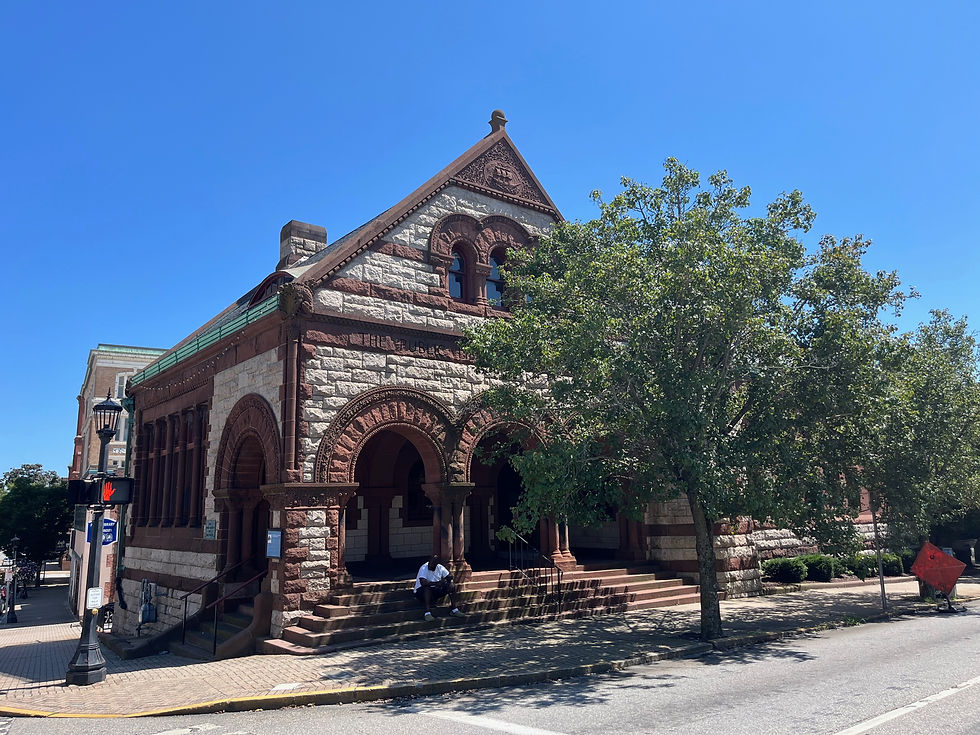
The New London Public Library appears to be Bill’s twin, although they did have different architects (both are Richardson Romanesques). It was a gift of the whaling, sealing, and shipping merchant, Henry P. Haven. It opened to the public in 1891.

The Fort Griswold Battlefield Park was adjacent to the library (you can see it in the background of the picture above) and, as the day was so warm and sunny I decided to explore it. I’m attracted to libraries, in part, because they are places of peace, understanding and, sometimes, love. The park reminds me again of how bloody and brutal our history has been. In 1781 troops under the command of (the then British) Benedict Arnold attacked colonials led by Colonel William Ledyard. The British demanded that the fort surrender and, if it didn’t, “no quarter” would be given to the Americans. Ledyard is reported to have responded “we will not give up the fort, let the consequences be what they may.” The American version of the story is that, after heavy fighting, Ledyard offered his sword in surrender to a British officer who, in turn, thrust it into Ledyard, killing him. The British proceeded to slaughter many of the wounded and the remaining soldiers. When the day was over, 85 Americans and 51 of the British were dead. Soon thereafter, the British abandoned the fort and the Americans resumed control.

More good luck. Driving through East Lyme I came across the Phoebe Griffin Noyes Old Lyme Library. Whenever I find a library named after a woman the hair on the back of my neck stands up. Old Lyme had some remarkable women: the book Remarkable Women of Old Lyme (by Jim Lampos and Michaelle Person, Charlestown, SC: The History Press, 2015) tells me so. I had to go in and see what’s what.

I approached the circulation desk and met:
Kristine: Horizontal white stripes on black dress; single strand of pearls, hair from gray to blond, blue eyes, brilliant smile, horn rim glasses.
Meg: black linen dress with ruffles on short sleeves, pink lipstick, blond/brown shoulder length hair, blue eyes, no glasses!
Had I written this up earlier, I would have been better able to elaborate on Meg and Kristine. I didn’t, so I can’t. I do remember that they were most helpful, and took me to the archives to look around. I rooted around a bit, and then Kristine brought me Remarkable Women. I bought a copy, gave them my warmest thanks, and went back on the road.
Over twelve chapters, Remarkable Women tells the story of seventeen women, who had been “pioneers in politics, business, education, and the arts. Perhaps the unique circumstances of the town’s settlement encouraged a strong streak of self-reliance and creativity in these women.” The term “library” does not appear in the index (it should); it looked at first glance like the women’s self-reliance and creativity were devoted to other ends.
Emilie M. Sill was the town’s most successful businesswoman, who ran a bookstore, which was also a lending library, and invested in real estate. Katherine Ludington was an artist and suffragette. Dr. Alice Hamilton was a medical pioneer (the first female faculty member at the Harvard Medical School) and peace activist. Most were artists or involved in the art world: Florence Griswold, Ellen Axson Wilson, Matilda Browne, Bessie Potter Vonnoh, Lydia and Breta Longacre, Elizabeth Tashjian, and Elizabeth Gordon Chandler. Louise Macleod Mitchell Jenkins, Cecil “Teddy” MacGlashan Kenyon, and Shirley Whitney Talcott were aviators. Ella Grasso was the first female to be elected a state’s governor who was not the wife or widow of a previous one.
Evelyn MacCurdy Salisbury was a writer and philanthropist. She and her husband, Yale professor of Sanskrit and Arabic, bought some property which they promptly donated to the Ladies Library Association; they also pledged to give their valuable collection of thousands of books from their own library and to provide the library an endowment. Sensing that the association was hesitant about the location of the donation, wrote an open letter to the Second Breeze which “excoriated the association for its failure to make a commitment” (p. 28): “its [the lot] somewhat retired position, apart from the constant noise and dust from the main street…must be regarded…in favor of its use for a library. The objection of inaccessibility is thus disposed of.” She urged the association to make a swift decision, concluding “It may, however, be best to postpone the opening of the library during our times, or, in view of the prospective difficulties and obstructions, it may prove best to give up the project altogether and forever [italics in the original, p. 29]. The library was built and, in her “exceedingly detailed will,” donated a large sum to the library and other educational causes, including $5000 to the Ladies Library Association.
The first of Old Lyme’s remarkable women was Phoebe Griffin Lord Noyes. Born to a prominent family in 1797, as a child she and her mother, Phebe (the mother preferred the simple spelling, while the daughter the more sophisticated one), were members of the Female Reading Society which met weekly for the purpose of “reading from the holy scriptures and any other book whose tendency is to elevate the mind and improve the heart.” As a young woman, she was – the Noyes-Gilman Ancestry writes – “very handsome, with light hair, beautiful gray eyes, fair skin, and rosy cheeks…full of fun, fond of society, and had a number of admirers.” After studying art in New York, she returned to Lyme, married Daniel Noyes, and became a teacher. Teaching was, of course, an honorable vocation, and one readily available to women of the time. A paycheck was nice, yet it seems that Phoebe was motivated (the authors hear) of her “intense desire to make the most of her life by stimulating and encouraging, intellectually and morally, the many who might thus be brought under her influence.”

Morally developing or not, Phoebe loved dancing and playing cards. She did believe that dancing (properly done) would be a “refining influence” on the young. Regarding the youth, Phoebe was “always ready, no matter how tired she was, to enter into the spirit of their frolics and amusements,” according to her granddaughter Katherine Luddington (p. 21).
The Ladies Library Association established a free public library in Lyme in 1897. The Phoebe Griffin Noyes Old Lyme Library building was a gift of her daughter, Josephine Noyes Ludington, and her son-in-law Charles H. Ludington. It is located on the homestead where Phoebe was born, and where she grew up with her father (who died when she was 15), mother, and sisters. It celebrated its 125th anniversary in 2023
Not all of the women of Lynme were talented, strategic, prudent, ambitious. Most notoriously, Josephine Noyes Rotch Bigelow, the “Fire Princess,” died in a suicide pact with her lover (they both were married), the “libertine poet and publisher” Harry Grew Crosby (p. 91) On their final night in 1929, she wrote him that “death is our marriage” and he wrote in his final diary entry “One is not in love unless one desires to die with one’s beloved” (p. 95). On the night Josephine and Harry killed themselves, they were both drunk. Harry and his wife, Caresse, had apparently earlier agreed that they would die together on October 4, 1944; it seems that a dramatic death had been on his mind, and his came earlier than his wife had imagined. Josephine’s tombstone reads “In Death is Victory.”
“It might be said that before there was a town, there was a library,” writes Laura Downes, former Interim Director of the E.C. Scranton Memorial Library in Madison, Connecticut. The earliest known library in the area was established in 1737, while Madison was incorporated as a separate town in 1826. In 1900 Mary Eliza Scranton opened the Scranton Library in a building she had donated. Her father, Erastus, was a wealthy man. She was the second Mary Eliza born to Erastus and Lydia; the first lived only to the age of two, and Mary Eliza was born a year after her namesake had died. A younger brother also died when two, and older brother lived only to be 24. When her parents passed away, she was the sole heir to the family fortune.

Mary Eliza’s niece, Mary, had studied to be a librarian in New York City, and she was the first librarian in the library her aunt had built. She served for eleven years; she also illustrated several books. Evelyn Merriweather succeeded her, leading the library from 1911-1951. With the exception of one man, Tim Kellogg, who served as the acting director for one year (2023-2024), all the other head librarians have been women: Miss Longlands, Charlotte Poirot, Sandra Long (1969-2011), Laura Downes (interim, 2018-2019), Sunnie Scarpa (2019-2023), and Allison Murphy (2024-present).

After serving generations of readers in more than a century of library service, the East River Reading Room in Madison is now a center for community events. When I drove by, I just had to pull in to take a photograph of this tidy green frame building with a bright yellow door. It was already after 4.30 when I slipped back onto the pavement, I still had six libraries I wanted to see, and I’m definitely no longer driving the open roads. The sun had just set after 8 when I arrived at the Carnegie in Mount Vernon, New York.
I had a 10 a.m. flight to Arkansas the next morning from LaGuardia and, to get there, I needed to park my car in a long-term lot and catch a shuttle bus. This meant that I would have to find a place to sleep fairly close to that lot so that I wouldn’t wake up every 30 minutes or so wondering if I would make it there in time. Mount Vernon, a suburb of New York just north of the Bronx, is densely populated and lacks – to my now fairly discerning eyes – many good places to stealth camp. I pulled into a slot along a long row of panel (business) vans and trucks, which seemed to be parked overnight. The street had heavy traffic and was loud, and it felt skeevy, so I moved on. The area also lacked chain hotels with ample parking lots. I settled on a Ramada in the Bronx, where I found a slot on the top deck of its parking deck. The corner where I parked already smelled like urine, so I figured “Hey, what’s a little more?” (No Alabama cops appeared to harangue me.) The deck had prison quality klieg lights. I wrapped my head in a t-shirt, as my eye muff had gone AWOL, took an Advil PM, locked the doors, and instead of sheep I counted my blessings.


Comments