


Day 114, Thursday July 11, 2024: Hamburg, New York to Solvay, New York
- Mark Carl Rom
- Oct 15, 2025
- 6 min read

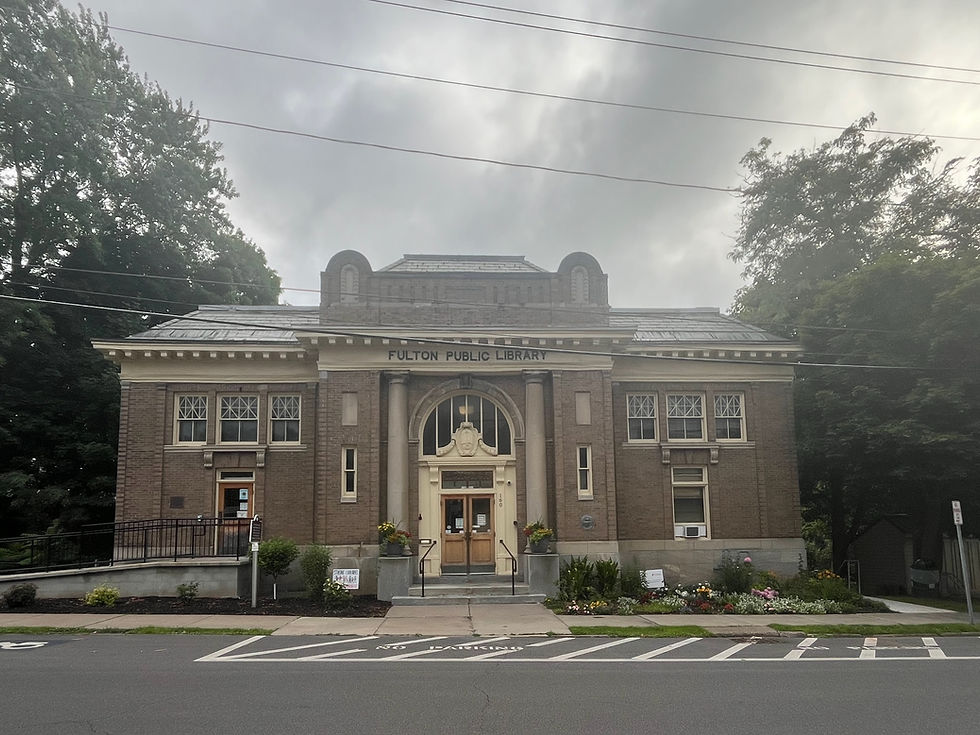
Carnegie libraries visited: Lackawanna, Fulton, and Solvay, New York
Days sober: 385
TripSavvy (“Vacation like a Pro”) lists nineteen of the United States’ natural wonders that should be on your bucket lists, if you keep such a list. I’ve recently heard a term more appropriate for someone approaching their 70th birthday: a fuckit list, on which you add things that you no longer aspire to accomplish (learning Chinese, winning a Pulitzer prize, etc.). Number 2 on the TripSavvy list is Niagara Falls. I’ve been lucky enough to hit virtually every other spot on TripSavvy’s list, and Niagara Falls has never been on my list (although I used to read about all the brave, crazy, vainglorious, or suicidal individuals who went over the edge, most unsuccessfully). It seemed silly to be within 30 minutes of the park and not so, so today I went.
What a disappointment. Those were the words I might have said if the Falls were not so spectacular. It was a misty morning even before I reached the overlooks, and the crashing torrent and rising droplets were mesmerizing. I was in awe, and had no desire to climb in a barrel and test my luck.

I’ve been listening a lot to the This American Life podcast. If you are reading this book, I doubt I have to tell you about this podcast, as you probably already know about it (media professor Andrew Bottomley wrote that the show reflected the perspective of its “predominantly white, upper-middle-class, educated audience” and it has won at least ten Peabody Awards) although – let me be clear – I hardly want to limit my audience to that demographic. If you are not reading this book, however, you should know that each week TAL explores a theme:“Getting Away With It,” “Say It To My Face,” “The One Place I Can’t Go” are on my upcoming playlist.
Two episodes I recently listened to earwormed me. In “Audience of One,” TAL shares stories of individuals’ memories of the movies they had watched over and over again, and how they remembered them. The show really is about the precariousness of memory. My favorite story was about a woman, Diane, who watched The Sound of Music many times as a child. A friend told her that, yeah, she loved it too, but got a little freaked out about the scenes involving Nazis.
Diane: “What Nazis?”
That’s when Diane learned that she had only been watching the first half of the movie, which came as a two-VHS box set. She, and her father, don’t remember ever seeing the second tape. For Diane, the first tape was the entire movie, which had a happy ending: the von Trapp children had sung their “Goodnight, farewell, auf wiedersehen, goodbye” song and Maria (Julie Andrews), realizing that her work with the children was done, returned to the monastery. The first half of the movie had most of the good songs and no Nazis (except for one Heil Hitler, which Diane had not remembered). When I talk with my friends and family, I’m reminded about how selective, and often deeply limited, my own memories are.
The other episode that rattles around my head is “How I Learned to Shave.” In this episode, Ira Glass – the show’s founder and host – relates that the only thing he remembers learning directly (that is, through explicit instruction) from his father was, well, how to shave.
This made me wonder: what instructions had my father given me? I remember only a few, clearly. When I was in 8th grade I couldn’t figure out how to solve mathematical proofs for my algebra class. One night, at the kitchen table, my father patiently showed me until a light came on: that’s how you do it! Once I saw that light, I worked through proof after proof, as if it were the most natural thing in the world. My dad also taught me how to fire a gun and especially how to do it safely. He taught me how to drive our tractor, and then a car, as we tooled around the gravel roads on the university’s experimental farm where he worked. Mainly, though, his instructions came through his daily actions: Be kind. Don’t boast. Work hard. Love your family. Respect yourself and those around you.
“Clara A. Wheelan, with Pioneer Study Club, secured funding from Carnegie Corp. of New York, to establish Lackawanna Public Library.” So reads the historical marker on the library’s front lawn. The Pioneer Study Club, a women's organization, came into being in 1909 and by 1914 they had established a committee to obtain a library, with Wheelan serving as the committee’s leader.

Clara (Kinne) was born in South Buffalo in 1869 and attended school until she was 14, and then continued her education with a tutor. She married William H. Whealen when she was 26 and they lived in Deadwood, South Dakota until 1905 (the Carnegie library in Deadwood opened that same year) when they moved to what would become Lackawanna, which at that time was still part of West Seneca. While Chair of the Pioneer Study Club, she designed the city’s seal and the “Art & Utility” monument in the Forest Lawn Cemetery. Because Clara was considered one of the town’s “most enthusiastic citizens,” Mayor John A. Toomey encouraged her to reach out to Carnegie. In one of Wheelan’s several letters to Carnegie, she outlined a very American reason for her request: “The majority of our people are of foreign extraction and the means for their proper Americanization are sorely lacking, and yet very much needed.”
In seeking this “Americanization,” library advocates were commendably open-minded. The Carnegie archives contain a couple undated articles, with no byline, from a weekly series on libraries in the Lackawanna Journal. In “The Libraries Part in Making Americans” the author – I have since learned that it was Clara Wheelan – argues:
Some library workers question whether it is right or patriotic to provide reading matter in foreign tongue and maintain that nothing but English be used. But that would retard their growth into Americans. The matter is no longer one for differences of opinion. [So, maybe, not entirely openminded.]
To everyone who loves his country one duty now stands out supreme: to develop in our ENTIRE population whatever their native tongue such devotion to our country and its institutions as shall put AMERICA first in the hearts of all who breathe our air or share our common life and privileges…
They need to be taught the meaning of citizenship, its privileges, a better understanding of the things for which this country stands. For the rendering of this service, there is no institution more fitted than the public library because there they can go for books, advice, and help and therefore there is no institution which rests more responsibility.
In a subsequent article, “Equality of Opportunity,” Wheelan asserts that
It is not strange that American communities are coming to deem it proper that all men have access to books. Public libraries have become a necessity…
With the great majority of foreigners in our midst we must awaken in them the meaning of citizenship, in a free public library America appears at its very best in the eyes of the foreigner. In its open doors are typified all that he has come to America to seek: opportunity, equality, freedom, and the privilege of education. Mr. Brown of the Buffalo Library says he thinks of them not as foreigners but as “New Americans”...
After three years of work, in 1917 Clara (along with other board members Addie A. Drake and Anna D. Trevett (the name is not fully legible) wrote to Carnegie to inform him that all the necessary local arrangements had been made to secure a grant, and Carnegie awarded the town $30,000.
The Journal wrote:
Mrs. Whealen is deserving of all the good things that the Journal can say for her in the landing of this big enterprise for this city and when we say that she has worked with the will of iron one does not grasp the real meaning of the word who has not followed her in the work, more or less, during the last two years.
For over two years Mrs. Whealen has written a weekly story for the Journal, that during the time has covered every phase of the situation that could have the least bearing on why we should have a library here and every week the Journal went to the Carnegie Institution and to the State Librarian at Albany.
The site selected for the library was the Howard Cemetery (known locally as the Potter’s Field) and, after receiving permission from the state, the bodies there were exhumed and cremated, as it was the only “Christian and sanitary option” (the ashes were placed in a ceremonial vault).
Carnegie’s gift had an expiration date – construction must proceed within two years, or the offer could be revoked. By 1921, sufficient progress had not taken place and the Carnegie Corporation believed that its money was no longer wanted. Mrs. Whealan wrote to Carnegie pleading for forbearance, as Lackawanna had to receive state aid to prepare the cemetery for its new occupant. Carnegie relented, and by later in 1921 ground was broken. One of the last libraries funded by Carnegie, the library opened its doors in 1922. Whealan, who served as the first president of the library’s board of trustees, got to enjoy the payoff of her persistence until her death in 1958.



Comments