


Day 109, Saturday July 6, 2024: Cleveland Heights, Ohio to Ashtabula, Ohio
- Mark Carl Rom
- Sep 29, 2025
- 6 min read

Carnegie libraries visited: Cleveland Jefferson Branch, Cleveland Sterling Branch, East Cleveland, and Ashtabula, Ohio
Carnegie libraries missed: Cleveland Lorain Branch, Cleveland Brooklyn Branch, Cleveland South Branch, and Willoughby, Ohio
Days sober: 380
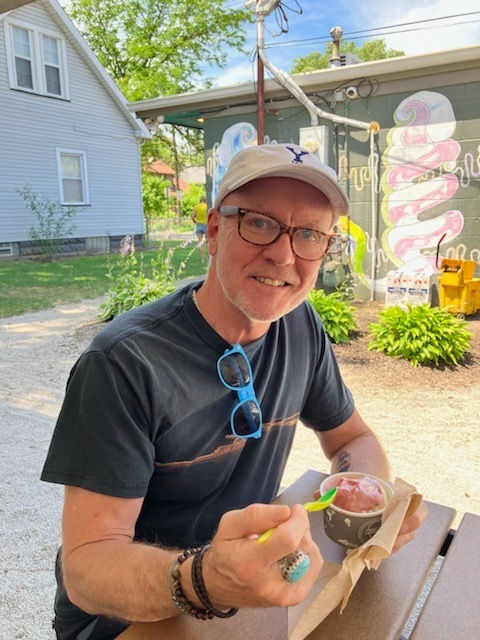
After four restful and feastful days at the R&R B&B, I’m ready to roll, as in roll like a donut, because I’ve been eating so much. I spent the 4th of July holiday like many Americans, doing little more to celebrate the sacrifice of those who helped Form a More Perfect Union than eating an ice cream cone and walking over to the local library to take a picture.
The Lee Road Branch of the Heights Libraries is a 4/10ths of a mile walk from Cristine & Alan’s home. A pleasant ten minute walk. (They can also easily walk to On the Rise, an excellent bakery; numerous cafes and restaurants, including the Stone Oven; Phoenix Coffee and Sophie la Gourmand; the Cedar Lee movie theater, which shows both art and popular films; and pretty much anything else one would need to walk to for the good life. Banks, pharmacies, and grocery stores are a bit further away.) They’re luckier than most Americans in having such a safe and walkable neighborhood. The “average” American lives just over two miles from a public library, although you are less likely to have a library close by if you live in a rural area or the South. Cristine, a retired academic library director, keeps her library card with her and uses it often.
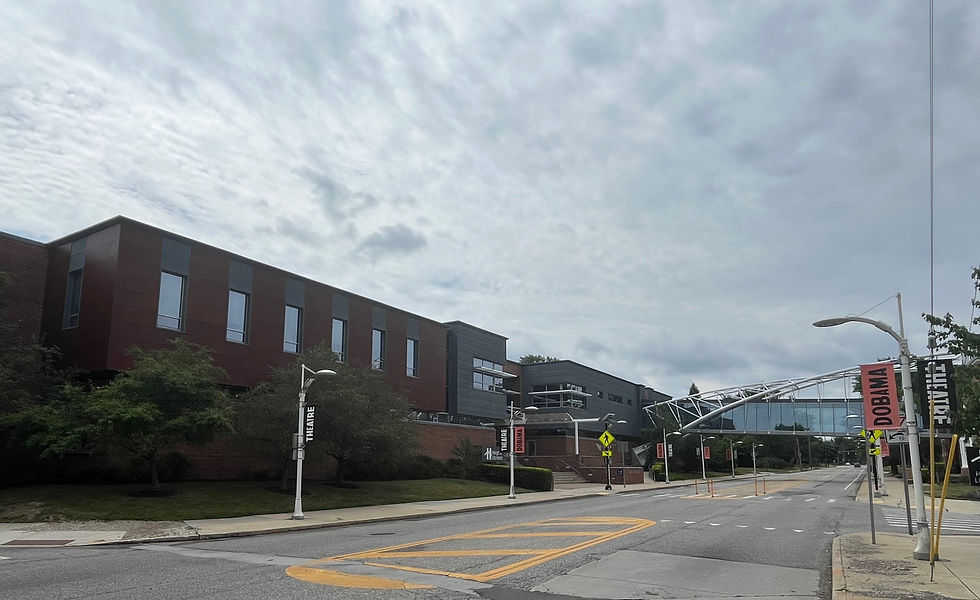
Cristine and Alan had taken me to an Independence Day cookout with some friends, which included a U.S. Senator, a Pulitzer Prize winning journalist, a couple of other Princeton PhDs, a guy who had been a political appointee during the Obama administration, and other highly accomplished individuals. No one seemed impressed except, obviously, me. Being patriots – the kind who believe in public service and civic duty, who understand that America continues to deserve love and criticism, and who worry deeply about our country’s future yet who have not given up hope for it – we had hot dogs, burgers, cole slaw, potato salad, and so forth while talking sports and politics. No fights broke out, and we ended the meal cautiously optimistic.
I sat next to another recovering alcoholic – word apparently had reached him that I was in the same boat – who was that weekend celebrating a couple of decades of sobriety. When our host was going around the table to take drink orders, one of the options was root beer. Oooh, I’ll have that, I said. He responded that he never touches anything called beer. That seems to work for him. Me? After a root beer, I might have a ginger ale. That seems to work for me; then again, he has about 20 years on me.
As I reflect back on this day, I realize that I did not go to four Carnegie libraries I had on my itinerary. Three were in Cleveland, and surely I had time to go to them during the four days I stayed there, so it appears that I just didn’t take the time. Three of life’s small regrets. The Carnegie in Willoughby looks to have been on right on my route, although now I remember that scenery trumped itinerary. Rather than heading directly to Willoughby and Ashtabula on I-90, I veered left onto Lakeside Drive, so I could follow the shore of Lake Erie.
I did make several stops on my way: the Euclid Public Library, with a WWII tank parked in front and the Polka & Softball Hall of Fame across the street (not open, dammit, as I would definitely gone for some polkaing and softballing lore); the public libraries in Willowick, Eastlake, Mentor-on-the-Beach, Mentor Headlands, Fairport Harbor, Painesville, Madison, and Geneva; and “The Strip” in Geneva-on-the-Lake. For the two miles between the Lakehouse Inn on the west and Sun Retreats Hotel on the east, Lake Road is lined with bars, shops, and restaurants. On a hot holiday Saturday in July, the traffic was as slow as the ketchup dripping down your chin as you held a hot dog in one hand and a margarita in the other and strolled with the other tourists. I rolled my windows down and enjoyed the crawl, with my buzz coming only from the sounds of the live music rolling down the street.
Ashtabula has two public libraries, the Harbor-Topky Memorial Library, across the street from Walnut Beach Park, and the Ashtabula County District Library. The County Library began as a subscription library in 1813, then it was incorporated as the Ashtabula Free Public Library in 1896. In 1900, Mrs. Richard Hubbard, a member of the library board, reached out to Carnegie to ask for help, noting that the existing library was in “one room over a fire engine house, which has no comforts or conveniences.” If Carnegie saw fit to give them a grant, the town would name it after him and would “be pleased to have you come and inspect” it.

Carnegie did not require libraries to be named after him, a gesture that speaks to the fact that his generosity was not just an attempt to burnish his reputation to aggrandize his accomplishments, although he didn’t object if recipients wanted to do that. Carnegie was one of the richest and most famous men in the world although, like any individuals both rich and notorious (say, Elon Musk, Bill Gates, Jeff Bezos, Mark Zuckerberg), their legacies are complicated, and I can’t help but wonder how much of the love/hate was simply due to the fact the he was as rich as Croesus. The American Experience documentary program created by PBS – and defunded by the Trump administration in 2025 – notes that labor unions at times lobbied towns to reject Carnegie funding to protest his labor policies, and that 225 towns were awarded grants before ultimately rejecting them. Ideology was not usually the reason for forgoing Carnegie cash, as more prosaic concerns (e.g., the unwillingness of the community to pay taxes to support a library) typically were.
A year passed and, not having heard from Carnegie, Mrs. Hubbard went to visit him in New York and “in obedience to the request of your secretary…I hand you this typewritten communication” in an effort to “give me the privilege of explaining to you more fully…the necessity of a library building.” The letter reiterates her earlier request, with a dollop of creamy flattery spread over the top: “We trust that you appreciate that we are animated by the same spirit that has prompted your great generosity…” Other letters from community members further articulate the community’s promise and needs.
In 1901, Carnegie gave Ashtabula $15,000. He was not the only generous donor: Maria Conklin left her entire estate to the town that same year for the construction of the Conklin Library Building (unlike Carnegie, Maria specified her name be used). When the library was built, it was called the Carnegie-Conklin Library. The Carnegie archives show that the town reached out to him again in 1904, seeking additional funding; those requests are rebuffed. It appears that Ashtabula was not forthcoming regarding Conklin’s gift, as it is mentioned nowhere in the Carnegie archives.

Maria Conklin is not mentioned, either, and I can find only the briefest mentions of her existence. In February 1902, the Library Journal mentions her bequest. The ‘Find a Grave” website has a picture of her tombstone, Celtic cross at the top, with the lonely text reading “Maria Conklin, 1832-1901.” Here’s hoping that the library staff can be as helpful as Lakewoods.

iOverland suggests that I can park overnight next to the marina in Lake Shore Park, so I head over late in the afternoon to check it out. It looks solid; thanks, iOverlander. It's a short drive to the Harbor Perk Coffeehouse & Roasting House to kill some time before the show tonight. Finally, I have tickets to a play, “My Son Pinocchio Jr.” at the Straw Hat Theater, and I’m thrilled. I had imagined that on most days when I was driving across the Midwest I would be able to catch a local baseball game, concert, or summer theater, while in fact most nights I watch Netflix inside Goldfinger.

Which I did again tonight. I arrived at the Straw Hat early so that I could hang out and enjoy the theater crowd. This crowd, I learned, was almost entirely parents, grandparents, aunts and uncles, and other assorted family members, as Pinocchio was the product of a theater camp for children. I felt like I was the only person in the audience who was not related to one of the players. Yeah, sure, juvenile theater is cute, especially if your children are involved and not especially if they are not. I snuck out at halftime and returned to the marina so that I could watch the sun slide into the lake before queuing up a video.


Comments